News & Insights
HRD Corp Levy Claim: How It Works, Eligibility & Step-by-Step Guide

If your company pays the HRD Corp levy, you may be able to use the levy or available financial assistance to support employee training and development.
But how exactly does an HRD Corp levy claim work?
In simple terms, the process generally involves selecting an eligible training programme, applying for grant approval through HRD Corp’s e-TRiS system before training begins, conducting the approved training and submitting the required claim and supporting documents after the training is completed.
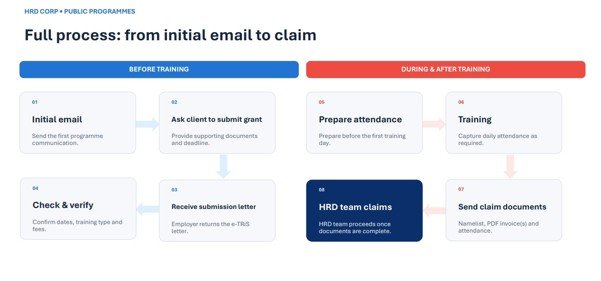
For many employers, the process can be summarised as:
Check eligibility → Choose training → Apply for grant → Receive approval → Conduct training → Submit claim → HRD Corp reviews claim → Claim processed
However, the exact requirements can vary depending on the HRD Corp scheme, type of training and expenses being claimed.
This guide explains the HRD Corp levy and claim process in Malaysia, including eligibility, e-TRiS, required documents, current 2026 requirements and common mistakes employers should avoid.
Important: HRD Corp requirements, claimable costs and application procedures may change. This article is intended as a practical guide and should be checked against the latest HRD Corp requirements before an employer submits an application or claim.
What Is the HRD Corp Levy?
The Human Resource Development (HRD) levy is a mandatory contribution imposed on employers covered under the Pembangunan Sumber Manusia Berhad Act 2001.
For eligible employers, the levy is intended to support the training, development, upskilling and reskilling of employees.
HRD Corp states that employers with 10 or more Malaysian employees in covered sectors are required to register, with the monthly levy generally charged at 1% of monthly wages. Employers with 5 to 9 Malaysian employees may register voluntarily, with the levy generally charged at 0.5% of monthly wages.
The exact registration requirement depends on whether the employer’s industry or activity is covered under the PSMB Act 2001.
How is the HRD Corp levy calculated?
The general calculation is:
HRD Corp Levy = (Basic Salary + Fixed Allowances) × Applicable Levy Rate
For example, if the applicable levy rate is 1% and the relevant monthly wages and fixed allowances total RM100,000:
RM100,000 × 1% = RM1,000 levy
HRD Corp provides specific guidance on what should and should not be included when calculating the levy.
Who Can Use the HRD Corp Levy?
registered employers covered by HRD Corp can access financial assistance through the applicable HRD Corp schemes to support employee training and development.
However, being a registered employer does not mean every training programme or expense is automatically claimable.
The training, training provider, application and expenses must meet the requirements of the relevant HRD Corp scheme.
HRD Corp’s employer FAQ explains that registered employers need to obtain training grant approval before sending employees for training, after which eligible expenses can be claimed subject to the approved amount or actual expenses incurred, whichever is lower.
Source: https://hrdcorp.gov.my/hrdcorp-claimable-courses
How Does an HRD Corp Levy Claim Work?
For a typical training programme, the process looks like this:
- Check your HRD Corp registration and levy positionBefore planning training, the employer should confirm that it is registered with HRD Corp and check its available levy or relevant financial assistance.The employer should also identify which HRD Corp scheme applies to the training.
- Choose an eligible training programmeThe employer identifies a training programme that meets its business and employee development needs.This could include areas such as:
- Leadership and management
- Human resources
- Communication
- Digital skills
- Artificial intelligence
- Finance
- Sales and marketing
- Workplace safety
- Technical skills
- Professional development
- Industry-specific capabilities
For HRD Corp Claimable Courses, HRD Corp provides requirements relating to the programme, training provider and supporting documentation.
- Submit the training grant applicationThe employer submits the grant application through e-TRiS.For HRD Corp Claimable Courses, HRD Corp lists documents such as:
- Quotation or invoice
- Training schedule or course content
- Trainer profile
HRD Corp may request additional documents where necessary for verification.
The important point: employers should not assume that they can simply conduct training first and claim afterwards.
HRD Corp’s general guidance states that grant applications must be submitted by registered employers before training commences.
- Wait for grant approval
The employer must receive the relevant approval before proceeding with the training according to the applicable scheme requirements.There are also specific 2026 requirements that employers need to understand.
What Changed for HRD Corp Claims in 2026?
This is particularly important for employers planning training in 2026.
HRD Corp introduced revised terms and conditions for several levy-based training schemes effective 15 June 2026, including HRD Corp Claimable Courses, SBL, SLB and Future Workers Training.
For in-house training, HRD Corp currently states that programmes can be conducted 14 days after grant approval, with the approved programme required to commence within 90 calendar days after the completion of the 14-day advance approval requirement.
For public training programmes, a temporary 2026 arrangement allows training to commence three days after grant approval, applicable from 15 June to 31 December 2026. HRD Corp states that from 1 January 2027, the requirement returns to the 14-day rule.
This means HR and L&D teams should build the approval timeline into their training planning instead of scheduling training immediately after submitting an application.
- Conduct the approved trainingOnce the applicable approval and waiting requirements have been fulfilled, the training can be conducted.Employers and training providers should ensure that the actual training matches the approved programme details.This includes keeping accurate records such as:
- Training dates
- Training attendance
- Participant information
- Training programme details
- Training provider information
- Relevant invoices and receipts
- Other supporting documents required under the scheme
Accurate attendance records are particularly important because HRD Corp requires attendance information as part of the claim process.
- After the approved training has been completed, the applicable claim can be submitted through e-TRiS.For HRD Corp Claimable Courses, HRD Corp states that:
- The grant must have been approved.
- Training must have been completed.
- The training provider’s claim must be approved before the employer submits its claim where applicable.
- Claims must generally be submitted within six months from the training completion date.
This six-month deadline is important.
A claim should not simply be submitted within six months and then left unattended. HRD Corp states that queries must also be responded to before the claim expiry date.
What Documents Are Required for an HRD Corp Claim?
The required documents depend on the scheme and the expenses being claimed.
For HRD Corp Claimable Courses, HRD Corp’s current guidance includes documents such as:
- Attendance documentation
- Itinerary for airfare, where applicable
- Receipts and invoices for transportation, where applicable
- Other supporting documents requested by HRD Corp
HRD Corp may request additional documentation for verification.
For SBL and SLB claims, HRD Corp provides different supporting-document requirements depending on the type of cost being claimed. These can include official receipts, tax invoices, e-tickets and other relevant documentation.
Therefore, employers should not assume that one universal document checklist applies to every HRD Corp claim.
How Long Do You Have to Submit an HRD Corp Claim?
For many HRD Corp training claims, the claim must be submitted within six months from the training completion date.
HRD Corp states that claims submitted after the six-month period will be rejected.
For example:
Training completed: 15 October 2026
Claim deadline: Generally within six months from the training completion date, subject to the applicable HRD Corp requirements.
The safest approach is not to wait until the deadline.
Submit the claim as soon as the required documents are complete and ensure that any HRD Corp queries are answered before the claim expires.
Can All Training Be Claimed Using HRD Corp Levy?
No.
Not every training programme, training provider or expense is automatically claimable.
The programme must meet the requirements of the relevant HRD Corp scheme, and the claim is subject to the applicable terms, allowable cost limits and supporting documentation.
HRD Corp provides an Allowable Cost Matrix for understanding eligible costs, maximum claim amounts and eligibility for different training types.
This is particularly important when planning expensive training programmes.
Before committing to a training programme, employers should check:
- Whether the programme is eligible
- Whether the training provider meets the relevant requirements
- Whether grant approval is required
- Whether the expenses are allowable
- The applicable maximum rates or limits
- Required supporting documents
- The applicable submission deadline
Example: How an HRD Corp Training Claim Works
Imagine that XYZ Sdn. Bhd. wants to train 20 employees in leadership and management.
Step 1: Company Identify the training need
The HR team for said company must identifies leadership development as a priority.
Step 2: Select a suitable programme and training provider
The company selects an appropriate training programme and training provider to provide the training.
Step 3: Connect with training provider – Discussion with training provider
The HR team and the training provider will have alignment calls to prepare the required information, such as:
- Training programme details
- Training schedule
- Trainer profile
- Quotation or invoice
- Employee information
Step 4: Company Apply grant through e-TRiS
The employer submits the grant application. Company provide grant number and the grant submission letter to the training provider.
Step 5: Obtain approval
The company waits for approval and follows the applicable 2026 waiting period before training begins.
Step 6: Conduct training
The 20 employees attend the approved training.
The comapny and training provider maintain the required attendance and supporting documentation.
Step 7: Submit the claim
After the training is completed, the relevant claim is submitted through e-TRiS by the training provider.
Step 8: Respond to queries if required
If HRD Corp requests additional information, the employer responds through the system.
Step 9: Claim is processed
Once the claim is approved, reimbursement is processed according to the applicable scheme.
*Step 10: Any additional allowance claims (if needed) by the company.