
News & Insights
Budget 2027: Minimum Wage to Rise to RM2,000 in June 2027. What Malaysian Employers Need to Know About Employment Law and Industrial Relations
Malaysia’s Budget 2027 has put wages, workforce readiness and employer responsibilities back in the spotlight. For HR professionals, the challenge extends beyond adjusting salaries. It also involves employment law compliance, employee relations, workforce planning and building a more productive workforce.
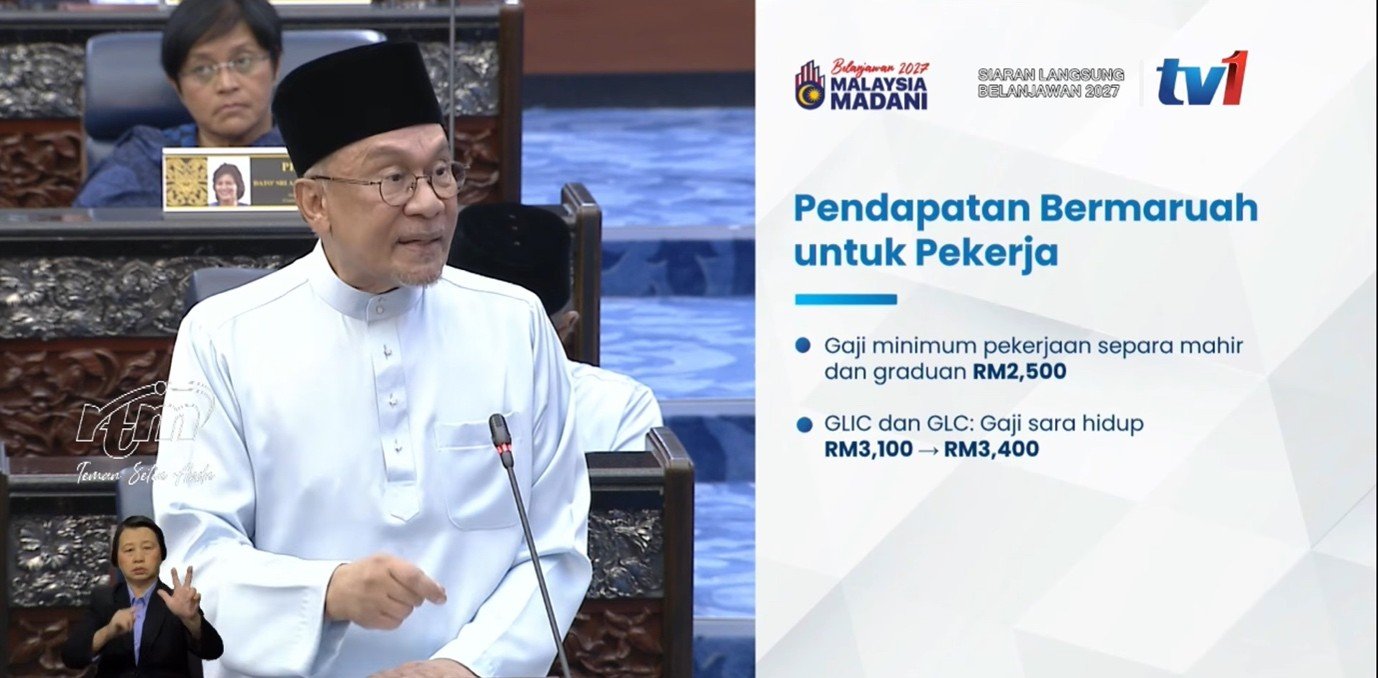
On 9 October 2026, Prime Minister and Finance Minister Datuk Seri Anwar Ibrahim announced during the tabling of Budget 2027 that Malaysia’s minimum wage would increase from RM1,700 to RM2,000 per month, effective June 2027. The announcement is expected to benefit more than four million workers.
The government also announced an exemption from the new minimum wage requirement for micro, small and medium enterprises (MSMEs) with annual sales below RM50 million to allow time for business adjustments. The detailed scope and implementation arrangements should be confirmed through subsequent official guidance.
Separately, the Prime Minister announced plans to reform the workers’ income framework, beginning with a proposed minimum monthly starting wage of RM2,500 for semi-skilled workers and graduates. The implementation details of this measure have yet to be fully clarified.
These announcements signal a broader conversation about fair remuneration, productivity and the relationship between employee capabilities and business performance.
For employers, the question is no longer simply how to comply with a new wage requirement. It is also how to prepare their organisations, review existing HR practices and develop the workforce needed to remain competitive.
So, what should Malaysian employers and HR professionals understand about the latest wage developments, the Employment Act 1955 and industrial relations?
Budget 2027 Minimum Wage Announcement: What Has Changed?
The announced increase from RM1,700 to RM2,000 represents an additional RM300 per month, or approximately 17.6% above the current rate.
For employers, particularly those with a sizeable lower-wage workforce, this development warrants early planning.
The official Budget 2027 speech identifies three relevant wage measures:
- National minimum wage: An increase from RM1,700 to RM2,000 per month, effective June 2027.
- Semi-skilled workers and graduates: The Prime Minister announced plans to reform the workers’ income framework, beginning with a proposed minimum monthly starting wage of RM2,500. Further implementation details are to be clarified.
- GLICs and GLCs: An increase in the living-wage benchmark from RM3,100 to RM3,400 per month, expected to benefit approximately 230,000 workers.
The Prime Minister announced that MSMEs with annual sales below RM50 million would be exempted from the new minimum wage requirement to allow time for business adjustment. Employers should monitor official guidance for further details on the scope of the exemption, eligibility and implementation.
These are distinct measures and should not be treated as interchangeable. The announced national minimum wage, the proposed starting-wage framework and the living-wage benchmark have different policy contexts. Employers should refer to subsequent official guidance for the final implementation details applicable to their organisations.
Source: Ministry of Finance Malaysia, Budget 2027 Speech.
| Item | Pay at RM 1,700 | Pay At RM2,000 |
| Basic Pay | RM 1,700.00 | RM 2,000.00 |
| EPF (11%) | – RM187.00 | – RM220.00 |
| SOCSO | – RM8.25 | – RM9.75 |
| EIS | – RM3.30 | – RM3.90 |
| Take-Home Pay | RM 1,501.45 | RM 1,766.35 |
Note: The take home pay figures are illustrative estimates based on the employee EPF contribution rate and the SOCSO and EIS deductions shown. Actual deductions may vary according to the applicable contribution schedules and individual circumstances.
What Should HR Teams Do Before June 2027?
Rather than waiting until the implementation date, HR teams can begin reviewing their workforce and compensation arrangements.
- Review existing salary structures
Identify employees earning below the announced new minimum and assess how the change could affect existing salary bands.
- Calculate potential payroll implications
Estimate the additional monthly and annual wage costs, taking into account the affected workforce and relevant employment-related contributions.
- Assess wage compression
When entry-level wages increase, the difference between entry-level employees, experienced staff and supervisors may narrow. Employers should review whether their salary structures continue to reflect responsibilities, experience and skills.
- Review workforce productivity
Consider whether job design, training, process improvements and technology can help employees contribute more effectively.
- Prepare management and payroll teams
Ensure that the people responsible for compensation, payroll, employment documentation and employee communication understand the changes and their implications.
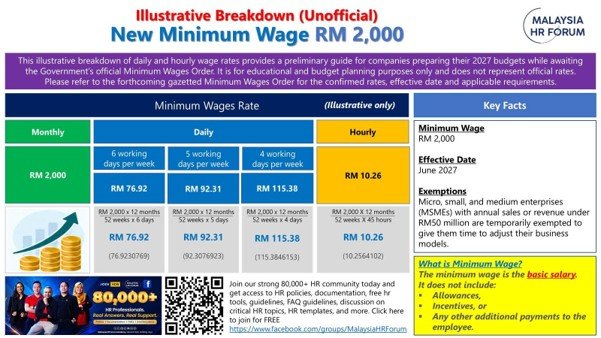
Source: https://www.facebook.com/share/p/1CYFPt5HrH/
These preparations can help organisations approach wage changes systematically instead of treating them as an isolated payroll adjustment.
Key Employment Act Areas HR Professionals Should Understand
Working hours and overtime
HR and payroll teams need to understand the applicable rules governing working hours, rest days, overtime eligibility and payment calculations.
Leave and employee entitlements
Employers should ensure that their leave policies, payroll procedures and management practices reflect applicable statutory requirements.
Flexible working arrangements
Organisations need a clear process for receiving, considering and responding to requests for changes to working hours, working days or place of work.
Disciplinary action and termination
Misconduct, poor performance, absenteeism and other workplace issues require appropriate investigation, documentation and decision-making.
Discrimination and forced labour
Employers should understand their relevant statutory responsibilities and establish procedures to identify and address workplace risks.
Employment law is not simply about avoiding penalties. It provides a framework for fairer and more consistent employment practices, helping organisations manage risk while maintaining employee trust.
Industrial Relations: Managing the Human Side of Employment
Employment law establishes important rights and obligations. Industrial relations focuses more broadly on the relationship between employers, employees and, where relevant, trade unions.
It involves managing workplace disputes, grievances, disciplinary matters and employment-related conflicts.
For HR teams and line managers, these issues often require judgement beyond simply reading a policy.
A disciplinary matter, for example, may involve determining the facts, reviewing the relevant policy, allowing the employee an appropriate opportunity to respond, maintaining accurate records and ensuring that the decision follows applicable law and fair procedures.
Similarly, poor performance may require a structured improvement process, clear expectations, appropriate support and consistent documentation.
When these matters are handled poorly, organisations may face employee dissatisfaction, workplace disputes, reputational damage and potential legal exposure.
When managed properly, industrial relations can help build trust, improve communication and support a more stable working environment.
This is why employment law and industrial relations are closely connected. HR professionals need to understand the rules while developing the judgement to apply them appropriately.
Learning Employment Law and Industrial Relations with Malaysia HR Forum
Understanding employment legislation is important, but applying it confidently to workplace situations requires practical knowledge and sound judgement.
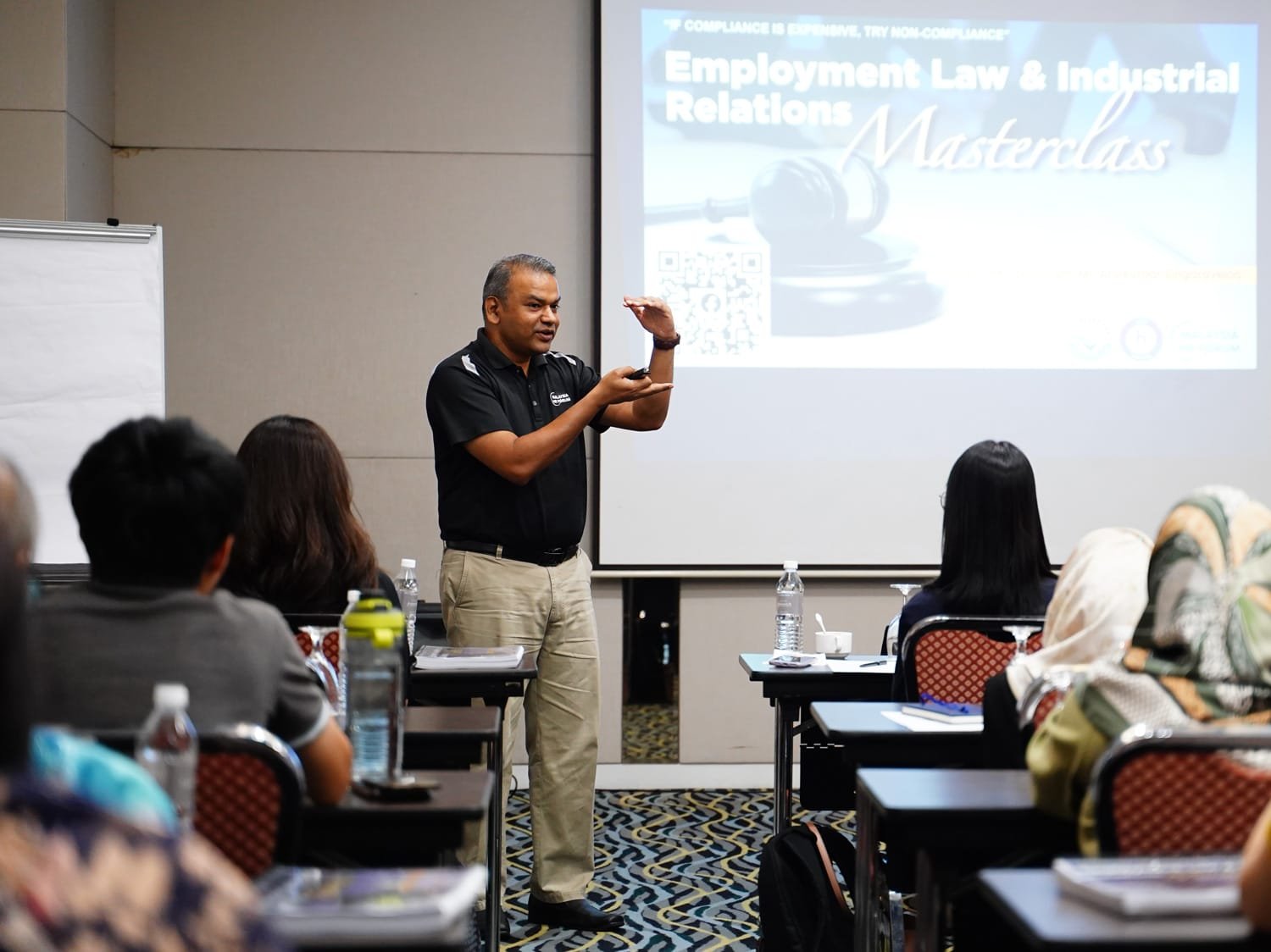
Malaysia HR Forum’s Employment Law & Industrial Relations Masterclass is designed to help HR professionals, managers and business leaders strengthen their understanding of Malaysian employment requirements and workplace relations.
The two-day programme covers key areas of employment law, industrial relations, disciplinary management, probation, performance management, grievance handling, termination and workplace compliance.
Through practical scenarios, discussions and interactive learning, participants can explore how employment requirements apply to common HR challenges and management decisions.
Meet the Trainer: Arulkumar Singaraveloo
Arulkumar Singaraveloo is Co-Founder and CEO of Malaysia HR Forum, a trainer and facilitator with more than two decades of progressive HR leadership experience. His career spans semiconductors, nitrile glove manufacturing, oil and gas, education and training, and transportation technology. He previously served as HR General Manager at Hartalega Holdings Berhad and Human Resources Director in Business Consulting Services at Infineon.
He holds a Master of Business Administration from the University of Strathclyde, Scotland, and has extensive experience in HR business partnering, recruitment, learning and development, employee relations, talent management, performance management, and compensation and benefits.
His professional expertise also includes labour and social compliance and forced labour prevention.
At Malaysia HR Forum, he brings this experience into professional development programmes that aim to connect HR knowledge with practical workplace challenges.
Preparing Malaysian HR Professionals for What Comes Next
Budget 2027’s minimum wage announcement has renewed attention on remuneration, workforce productivity and the future of employment in Malaysia. For employers, preparing for these developments requires more than updating payroll figures. It calls for a broader review of compensation structures, workforce capabilities, employment practices and employee relations.
As organisations navigate changing expectations, HR professionals play an important role in translating policy and legal requirements into practical decisions that support both employees and business performance. Through its training programmes and HR knowledge-sharing initiatives, Malaysia HR Forum aims to help practitioners build the knowledge and capabilities needed to manage these challenges.
Looking to strengthen your organisation’s employment law and industrial relations capabilities?
Explore Malaysia HR Forum’s Employment Law & Industrial Relations Masterclass or contact our team to discuss training solutions for your organisation.
https://malaysiahrforum.com/public-training/employment-law-industrial-relations-masterclass-pj/